technology with real-world impact

AI + formal methods

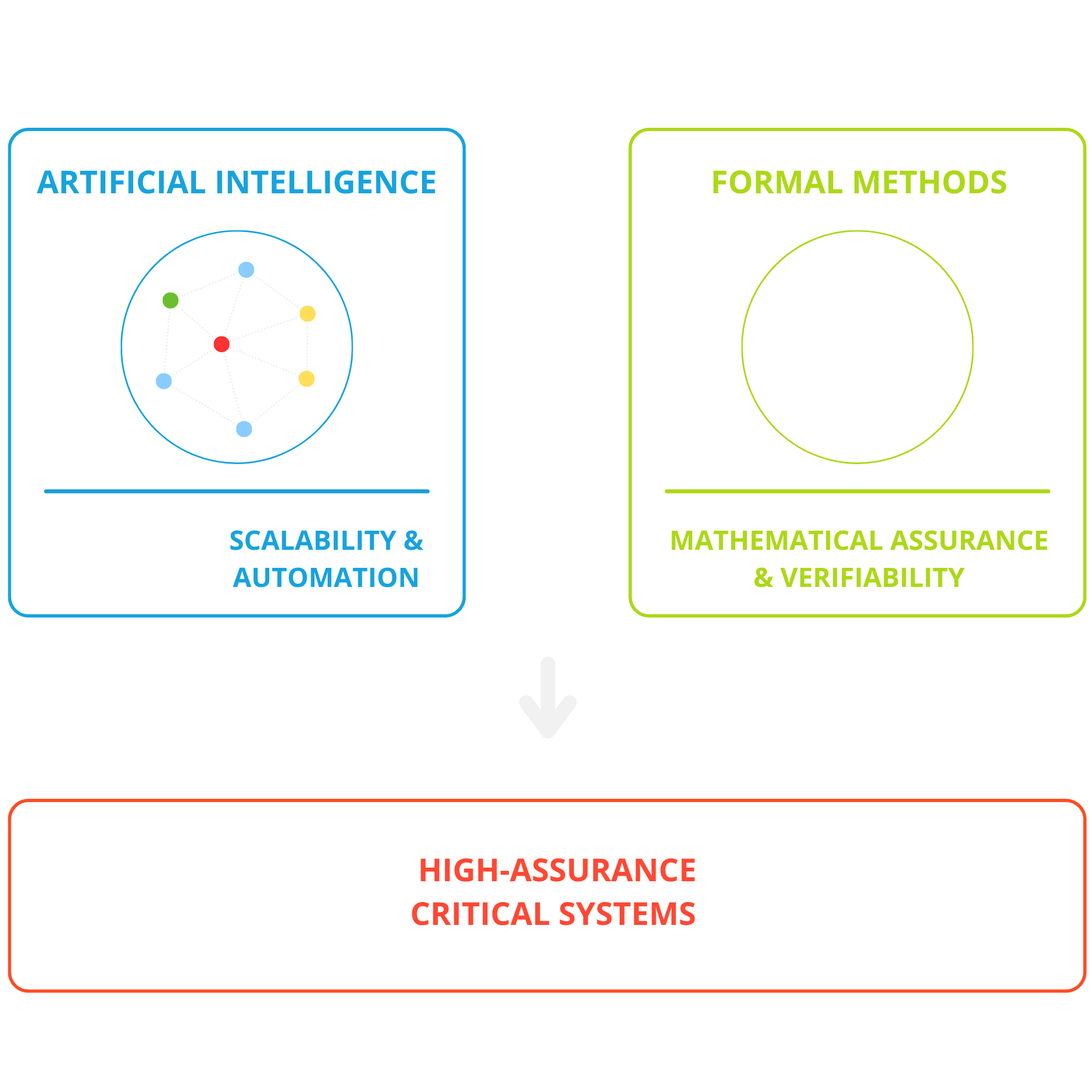
Galois combines AI and formal methods to deliver high-assurance systems. AI provides speed and scalability to automate complex processes, while formal methods provide mathematical evidence that critical outputs are correct.

AI + Formal Methods
The Challenge
Trustworthy AI
Scalable FM
Stronger Together
Examples
Why Galois?

the challenge

From software development to transportation, manufacturing to healthcare, defense and beyond, AI is transforming the way work happens – automating complex workflows, accelerating decision-making, and helping experts tackle real-world problems. Yet, for all its power, AI is not reliable or trustworthy on its own.

Today’s AI models are optimized to produce useful outputs, not to prove those outputs are correct. Rather than guaranteeing correctness up front, AI relies on post-hoc testing, human review, or waiting for post-deployment failures to catch errors. Their reasoning remains opaque, and plausible-sounding results can hide critical flaws. That might be fine for low-stakes applications, but when AI controls medical devices, financial systems, critical infrastructure, or defense platforms, “probably correct” isn’t good enough.

formal methods makes ai trustworthy


Formal Methods are a set of mathematically rigorous techniques used to specify, write, analyze, and verify software systems. They go beyond traditional testing by using logic-based reasoning to prove that a system behaves correctly under all possible conditions.

When applied to AI systems, formal methods increase rigor by proving that critical outputs and properties meet specifications and producing traceable evidence that can be independently verified. Ultimately, this accelerates the path from development to deployment by pairing the probabilistic nature of AI with the deterministic evaluations of formal methods to verify AI output at machine speed and scale.

Ai makes formal methods scalable


Simultaneously, AI is changing the game for formal methods. Traditionally, formal verification has been impactful, but difficult to scale. Constructing formal proofs is difficult, even for experts, often requiring immense time, specialized knowledge, and painstaking effort. Outside the most critical systems, costs can quickly become prohibitive. 

AI can automate the most difficult and time-consuming parts of formal verification – including coordinating tools, generating specifications, proving theorems, and verifying AI-generated code. This makes formal methods dramatically faster, cheaper, easier for non-experts to use – practical and scalable across larger projects and more systems.

stronger together


Formal methods and AI thus work in a virtuous cycle:

Formal methods make AI-powered systems safer, more reliable, and trustworthy.

AI makes formal verification practical to apply at industry scale.

Together, they enable high-assurance automation. The speed and reach of AI, backed by mathematical evidence that critical systems behave only as intended.


ai + formal methods in action


Galois is actively applying this hybrid approach to solve complex engineering and security challenges:

  • Legacy Code Verification: Using AI to execute formal verification on legacy VPN software, evaluating system correctness rapidly at scale.
  • Embedded Formal Reasoning: Applying reinforcement learning to reorient AI models towards formal logic, improving their capacity to reason about code.
  • Automated Specification Generation: Leveraging AI to translate unstructured documentation, policies, and vulnerability reports into machine-readable formal specifications for network verification.
  • Correct-by-Construction Parsers: Leveraging Galois technology via AI agents to automatically generate custom, memory-safe, and highly precise parsers.
  • Automated transpilation: Using both symbolic and AI tools in a step-by-step refactoring loop to incrementally rewrite C code into safe, idiomatic Rust.

Why Galois?


For more than 25 years, Galois has pioneered formal methods for some of the world’s most pressing software and security challenges. By combining that expertise with modern AI and agent frameworks, we help organizations build systems that are not only more capable, but demonstrably more trustworthy.


Ready to learn more?